Open build Morris County, New Jersey + remote

Help build a humanoid from the hand up.

Jersey Dynamics is a student-led, open-source project developing an affordable modular robot for useful household tasks. The first subsystem is not a render. It is a four-digit underactuated hand, already being built and debugged.

01
Physical prototype
04
Digits: two fingers, two thumbs
OPEN
Code, CAD, testing, operations
JD HANDLAYOUT / REV 0.1
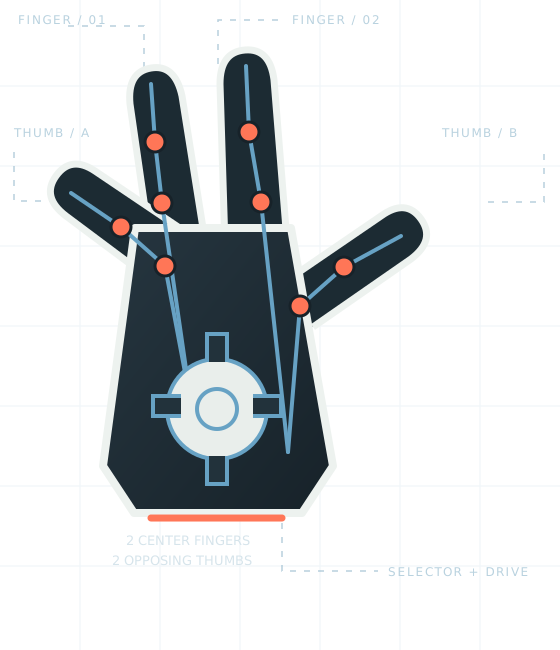
JD Hand layout with two center fingers and one opposing thumb on each side
Four digits. Underactuated. Designed to learn from one drive system before scaling complexity.

On the bench now

Gear-mesh reliability, selector behavior, repeatable motion, and sensor placement.

Work on JD Hand →
01 / THE BUILD

Started with a stubborn prototype

We are building the evidence before the full robot.

A humanoid can become a collection of ambitious drawings very quickly. Jersey Dynamics starts smaller: build one subsystem, document what fails, measure what improves, and only then decide what deserves to scale.

The current hand uses two center fingers and two opposing thumbs. That layout is intentional: it tests useful grasping with fewer actuators and a simpler mechanical architecture.

Follow the build on GitHub ↗
JD HAND / V0.1BUILD LOG
BuiltPhysical hand prototypeCAD → print → assembly
NowDrive and gear reliabilityBinding, backlash, repeatability
NextPosition sensingClosed-loop motion
ThenRelease candidateTest data + build documentation
02 / FIND YOUR PLACE

Different skills, one machine

Choose the work you would genuinely want to own.

You do not need to be a robotics expert. Pick the kind of problems you like, and we will route you toward a scoped first contribution.

How we work

Useful progress has receipts.

Every track should leave behind something another person can inspect, test, reproduce, or improve.

  1. 01
    Define the question

    Write the requirement, constraint, cost target, and interface before building.

  2. 02
    Make the smallest test

    Build only enough to answer the question cleanly.

  3. 03
    Record what happened

    Keep measurements, failures, decisions, and revisions—not just the final result.

  4. 04
    Release the learning

    Share the code, CAD, BOM, tests, and next problem.

Open call

You can join before the robot is finished.

That is the point. Choose a concrete way in, tell us what interests you, and we will follow up with a realistic first step.